The First Two Metres: How to Keep Winter Muck Out of the Rest of the House
There is a particular moment in late autumn when the front door stops being a doorway and starts being a mudslide. The pavements have that grey, salty sheen, the park has given up pretending to be a path, and every arrival home brings a small deposit of the outside world onto your hall floor. By the time you have hung up your coat, the grit has already been walked six feet in and is quietly grinding itself into the boards.
The good news is that you do not need to deep-clean the hall every evening. You need a system that works in the first two metres inside the door — and a short, repeatable reset once a week. Everything beyond that is damage limitation, and damage limitation is much easier than damage repair.
Think of the hallway as a series of filters
Most homes treat the doormat as a single line of defence. It is not. Grit and water arrive in layers, and the sensible approach is to remove a bit at each stage: outside the door, just inside the door, and then at the point where hard flooring meets carpet or stairs.
A rough, bristly mat outdoors does the heavy lifting — it scrapes off the worst of the mud and the salt before anyone steps in. Inside, a shorter, absorbent mat soaks up the moisture that the outdoor mat missed. If your hall is long, a washable runner between the two is worth its weight in saved floor finish, because it gives wet soles one more chance to shed grit before they reach the good flooring.
Rotate them. Two sets of mats, swapped over on a Sunday, means one can be hosed down and dried properly while the other does duty. Mats that stay permanently damp are worse than no mats at all: they hold moisture against the floor and start to smell faintly of wet dog.
The boot routine nobody teaches you
Here is the habit that makes the biggest difference, and it takes about eight seconds. When you come in, step onto the outdoor mat, kick your heels together to knock off loose clods, then step inside and take your boots off while standing on the absorbent mat — not on the bare floor. Carry wet boots to wherever they dry rather than walking them through the house.
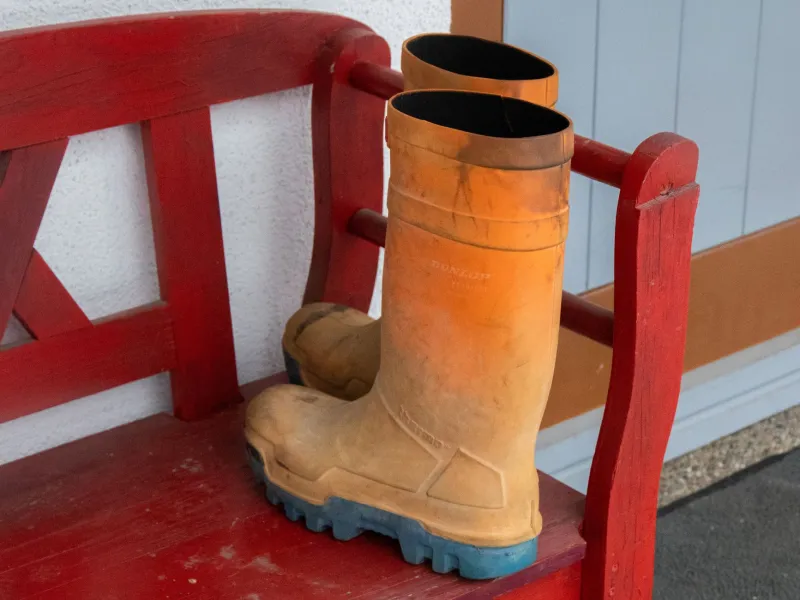
For wellies and walking boots, a stiff brush kept by the door earns its place. Brush downwards, from the ankle to the sole, and pay attention to the tread. That is where the grit hides, and it is also where it drops out later, usually in a trail across the kitchen.
If you have children, this is the one routine worth being mildly annoying about. A small stool by the door, a brush within reach, and a rule that shoes come off on the mat rather than beside it will save you an astonishing amount of mopping between now and March.
Muddy paws are a separate problem
Dogs and wet weather are a combination that no mat can fully solve. Keep a microfibre cloth or a small towel in a basket by the door and wipe paws before the lead comes off, working from the top of the leg down to the pads. A shallow plastic tray with a centimetre of warm water handles the worst of it on truly filthy days — a quick dip, a dry, and the dog can go and lie on the sofa with a clear conscience.
Dry the paws properly, including between the toes. Damp paws left to settle on wood or laminate leave dull patches over time, and the smell of wet fur in a warm hallway is its own incentive.
Cleaning floors without wrecking them
The floor-safe part of all this matters more than people expect. Winter mess needs cleaning, but harsh treatment does more harm than the grit ever did.
On tiles and sealed stone, sweep or dry-mop first to lift the grit, then wash with warm water and a pH-neutral cleaner. Never scrub dry grit across a tiled floor with a wet mop — you are effectively sanding the surface. Change the water often; a bucket of grey sludge simply redistributes the problem. If your tiles have textured surfaces, a soft brush works better than a flat mop.
On wood and laminate, keep water to a minimum. A slightly damp mop, wrung until it barely drips, is the right tool, and it should be followed by a dry pass with a microfibre cloth. Standing water is the enemy of every timber floor, particularly near the door where the finish is already taking a beating. If you use a steam cleaner, check the manufacturer's guidance first — many wood floors should not see one.
Salt stains on hard floors respond well to a dilute solution of white vinegar and water, but test on an inconspicuous patch first and rinse afterwards. On carpets and runners, vacuum thoroughly once the pile is dry rather than while it is damp, and treat mud patches by letting them dry completely and then brushing out the residue before dabbing with a mild detergent solution.
The twenty-minute weekly reset
Pick a day — Sunday evening works for most households — and run through the same short list. Shake out the outdoor mat and give the indoor mats a good vacuum on both sides. Sweep the grit from the corners where it collects, which is almost always to the left or right of the door and under whatever the coat rack has become. Wipe the skirting boards to knee height, because that is where splashes land. Mop with the appropriate cleaner for your floor, then dry it.
Finish with the door furniture: handles, the letterbox, the light switch by the door. These are the most-touched surfaces in the house during winter and the least often cleaned. Two minutes with a cloth and a general-purpose spray makes a visible difference, especially if you have guests coming.
A small kit that stays by the door
Keep it together so nobody has to hunt for it: a stiff brush, a microfibre cloth or two, a spray bottle of neutral cleaner, a spare pair of mats in rotation, and a small basket for wet gloves and hats. It is not glamorous, but it is the difference between a hallway that shrugs off November and one that slowly turns into a warning sign.
Winter will still arrive, and the pavements will still be grim. But if the first two metres are working properly, the rest of the house barely notices.